
Top Signs You Need Garage Door Service – Don’t Ignore These
A garage door that takes three seconds longer to open than it did six months ago isn’t “getting old.” It’s a measurable symptom of spring tension loss, and that spring is now carrying roughly 15% to 20% less counterbalance than your door’s weight requires. The sign is small. The cause behind it isn’t. Most serious garage door failures in Oakley announce themselves weeks in advance through slow travel, odd noises, or a remote that needs a second press. Homeowners who read those signs early spend a lot less than the ones who wait for something to snap. If you’d rather have a professional look at it than climb a ladder yourself, call (877) 492-3387.
Which Five Warning Signs Actually Point to a Failing Door?
The five most telling warning signs are slow travel, grinding or scraping noise, uneven movement, remote lag, and a visible gap at the floor. Each one maps to a specific mechanical cause. That mapping matters because it tells you whether you’re looking at a minor adjustment or a part that’s close to failing.
- Slow travel usually means the torsion spring has lost tension or the opener is straining against added resistance. A door that used to open in one smooth motion and now labors is telling you the counterbalance is off.
- Grinding or scraping points to worn rollers, dry hinges, or a track that’s out of alignment. Metal-on-metal sound means friction is building where there should be none.
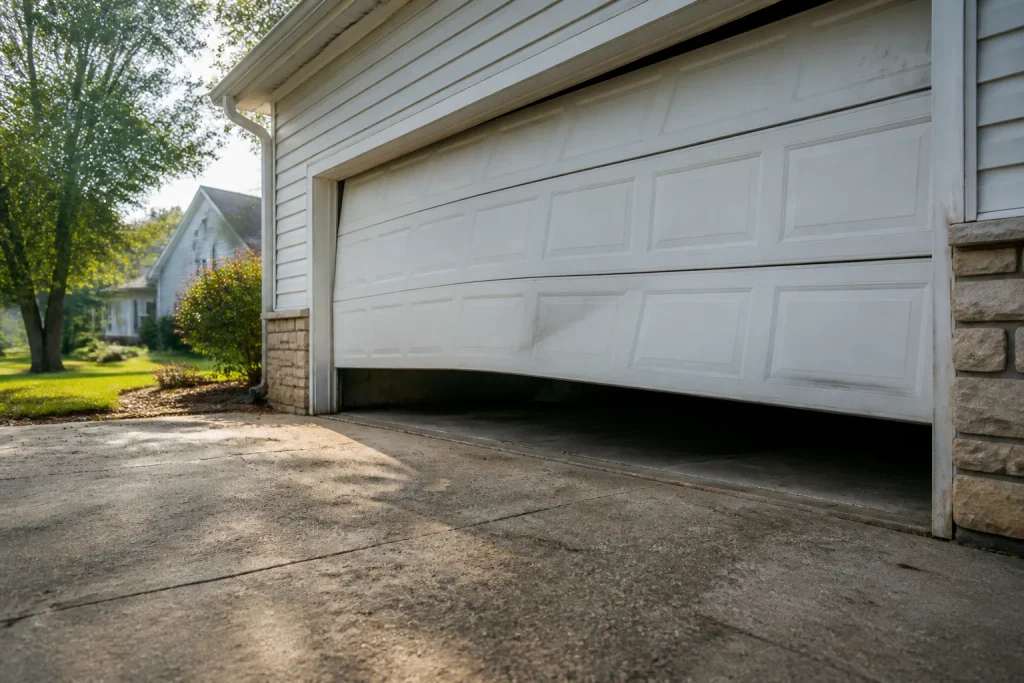
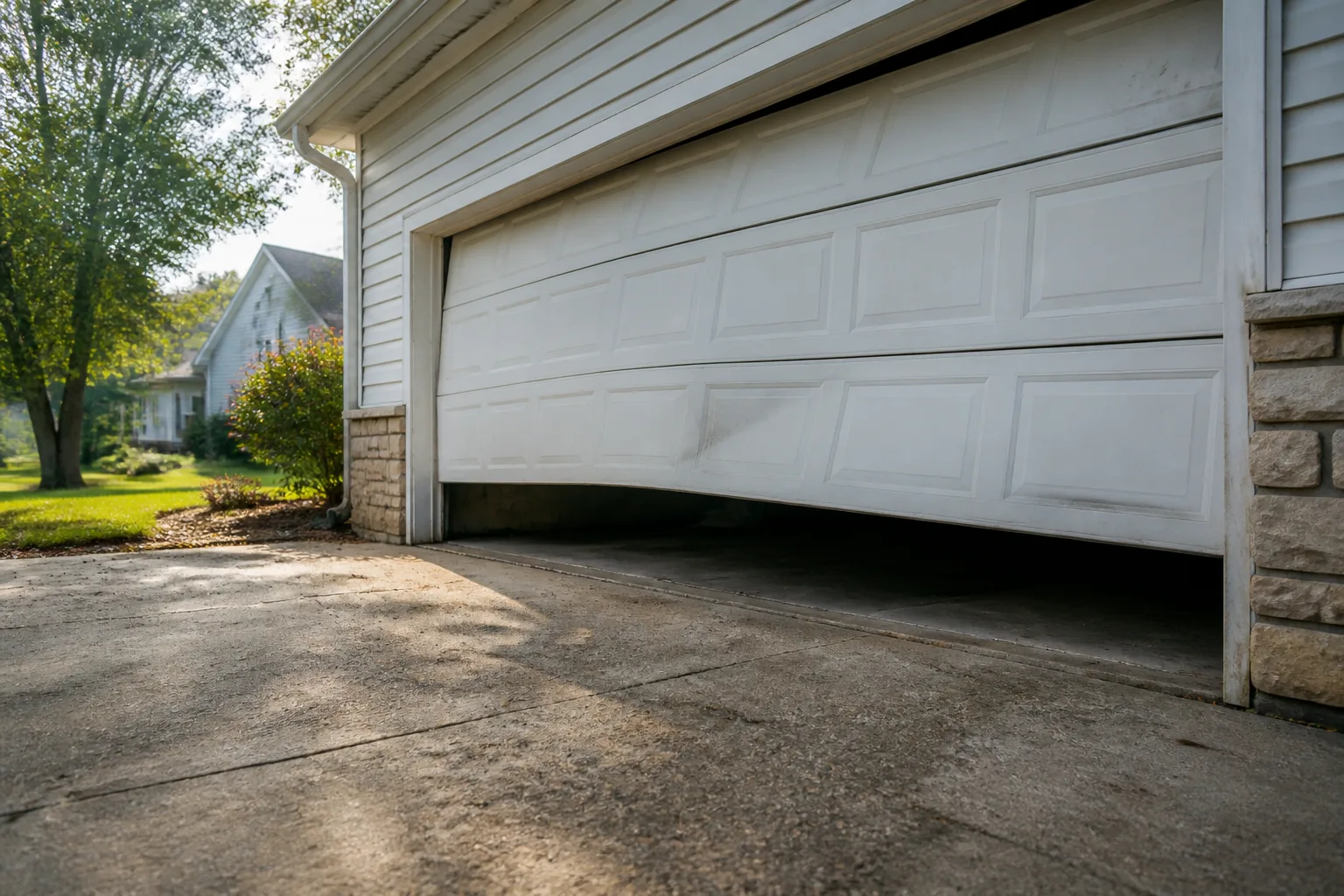
- Uneven movement (one side rising faster than the other) is almost always a cable or spring problem. A door that tilts as it travels is under uneven load, and that stress compounds.
- Remote lag places the issue in the opener head or the safety sensor, not the door hardware. If you press and nothing happens for a second or two, the motor or sensor is your starting point.
- A gap at floor level means the bottom seal has deteriorated or the door isn’t closing squarely. It’s the quietest sign on this list and the easiest to ignore, which is exactly why it matters for security.
We see these five patterns constantly in Oakley, and they don’t appear in random combinations. Slow travel with uneven movement is a spring-and-cable story. Grinding with a floor gap is almost always a roller-and-seal story. Read the combination and you’ve found the cause before anyone touches the door.
Why Does My Door Reverse on Its Own?
A door that reverses unexpectedly is doing what it was designed to do: it’s sensing resistance and pulling back. That’s not a button to keep pressing. It’s a safety sensor or a force calibration problem, and ignoring it means you’re overriding the one mechanism that stops the door from closing on a child, a pet, or a car hood.
The two most common causes are a misaligned photo-eye sensor and a force setting that’s drifted out of spec. Photo-eyes are the small lenses near the floor on each side of the door. If they’re knocked out of line, dirty, or blocked by a stored item, the door reads an obstruction that isn’t there. Force calibration lives in the opener’s settings. When the door’s resistance changes (a sticky roller, a loosening spring), the opener may register that extra load as an obstruction and reverse.
On modern units from LiftMaster or Chamberlain, the sensor indicator light is your first diagnostic. A flickering light means the eyes aren’t communicating. A steady light on one side only means one sensor has failed. What you should not do is adjust the force setting higher to make the door close. That masks the symptom and removes your safety margin. A trained technician can read the sensor and force settings accurately and put the door back within its designed limits. Our technicians have up to 8 years of experience working these systems.
Is It the Opener or the Door? How to Tell Where the Problem Lives
Split the problem into two halves: the motor head and the door hardware. The motor head is the unit on the ceiling (the opener). The door hardware is the springs, cables, rollers, hinges, and tracks on the door itself. Most homeowner confusion comes from treating these as one system when they diagnose very differently.
Signs the problem is in the opener
- The door is silent when you press the remote, or the opener hums without moving the door.
- The wall button works but the remote doesn’t (or the reverse).
- The light on the motor head blinks in a pattern, or the unit beeps.
- The remote needs multiple presses or works only up close.
Signs the problem is in the door hardware
- The door moves but the opener sounds normal.
- The door is heavy to lift by hand (with the opener disconnected).
- You hear grinding, squealing, or a bang during travel.
- The door hangs crooked or binds partway up.
The disconnect test is the cleanest diagnostic a homeowner can do. Pull the release cord to disengage the opener, then lift the door by hand. If it rises easily and stays put halfway, your hardware is sound and the issue is in the motor head. If it’s heavy, drops, or binds, the problem is mechanical and no amount of opener adjustment will fix it. If you’re not comfortable running that test, our garage door opener repair team can tell you which half of the system is failing.
What Can You Check Yourself in Five Minutes?
Four visual inspection points cover most of what a technician looks at on arrival: cables, rollers, the bottom seal, and spring condition. None of them require tools, and all of them are safe to look at from the ground. What you do with what you find is where professional help comes in. These are checks to perform, not repairs to attempt.
- Cables. Look at the steel cables that run along each side of the door. They should be taut and evenly wound on their drums. Fraying strands, slack, or a cable off its drum is a red flag and means stop using the door.
- Rollers. With the door closed, look at the rollers in the track. Worn rollers wobble or look flat-sided. Chipped nylon or dry metal rollers are a grinding noise waiting to happen.
- Bottom seal. Close the door and look along the floor line from inside. Daylight or a visible gap means the seal has compressed, torn, or pulled loose. It’s a cheap part and a security issue when it fails.
- Springs. From the ground, look at the torsion spring above the door (or the extension springs along the sides). A visible gap in a torsion spring means it has broken. Never touch, adjust, or attempt to wind a spring. High-tension springs and cables store enormous force and cause serious injuries to untrained hands. This is one inspection where “look but don’t touch” is the whole rule.
That’s the entire five-minute check. In Oakley, the seasonal temperature swings put real stress on springs and seals, so a quick look each season catches most problems while they’re still small. If anything on that list looks wrong, that’s your signal to book a professional inspection before the door gets more use.
How Fast Does a Warning Sign Become a Failure?
Most warning signs move from nuisance to failure on a predictable timeline, and the cost jumps with each step. A fraying cable can fail within weeks. A weakening spring can snap without warning once it reaches its limit. The pattern is consistent enough that we can tell homeowners what to expect if they wait.
- Grinding or squealing: weeks to months before a roller seizes or a hinge fails. Lubrication and roller replacement are inexpensive now; a seized roller can damage the track and the door panel.
- Slow travel or a heavy door: weeks. A spring that’s lost tension keeps losing it, and the opener absorbs the strain until the motor or the gear wears out. Fixing the spring protects the opener.
- Fraying cable: days to weeks. A snapped cable can whip, drop one side of the door, and bend panels or the track. This is the classic $180 cable repair that becomes a $600 door panel replacement if ignored.
- Unexpected reversing: immediate. This is a safety failure, not a nuisance. Stop using the door until it’s diagnosed.
- Floor gap or a misaligned door: months. It’s a slow deterioration, but it’s also your home’s security boundary. A gap is an open invitation.
The math is simple. Early repair is almost always the smaller number. In our experience across Oakley, the calls that start with “I noticed it a while ago but thought it would be fine” are the ones that end with panel and track work.
When Should You Call a Pro Instead of Waiting?
Call a pro the moment a symptom involves a cable, a spring, a door that’s stuck open, or a door that reverses. Those four situations are where DIY turns dangerous or where a small repair becomes a structural one. Everything else (a squeaky roller, a worn seal, a remote that needs a battery) can wait a few days without real risk.
Spring replacement in particular is precision work with brand-matched parts and exact tensioning. It’s not a commodity fix. Our technicians come already familiar with Craftsman, Raynor, LiftMaster, and Chamberlain systems, so the diagnosis doesn’t start with a guess about your door. We handle mechanical repair, opener repair, spring replacement, and full installation under one roof, so you’re not calling a different contractor for each problem. Our technicians have up to 8 years of experience, and the price is quoted and agreed before any work starts. If a door fails outside normal hours, we answer 24/7. A call outside dispatch hours is booked into the next opening, Sunday through Friday, 7am to 7pm, and we’re closed Saturday.
Related services in Oakley: for hardware and spring issues, see our garage door repair page. For a door that’s beyond repair, our garage door installation service covers replacement and new-door setup. You can also reach the Oakley Garage Door Repair Pros homepage for the full picture of what we handle.
The Bottom Line
Slow travel, grinding, uneven movement, remote lag, and a floor gap are five different symptoms with five different causes, and reading them right is what separates a small repair from a large one. A door that reverses on its own is a safety matter, not a button issue. And the five-minute inspection (cables, rollers, bottom seal, springs) tells you more than a month of ignoring the door ever will. If you’re in Oakley and want a professional to look at any of these warning signs, Oakley Garage Door Repair Pros offers free estimates: call (877) 492-3387 today. We’ll tell you what’s wrong, what it costs, and what happens if you wait. No surprises in the invoice.
Frequently Asked Questions
A spring that’s going bad usually shows up as a door that feels heavy, opens slowly, or rises unevenly, and you may hear a loud bang when a torsion spring finally breaks. From the ground, look for a visible gap in the torsion spring above the door. If you see one, stop using the door and call a professional. Springs and cables store dangerous force and should never be adjusted by a homeowner. Call (877) 492-3387 for an inspection.
Yes, it’s serious. A door that reverses unexpectedly is responding to a sensor or force calibration issue, and that mechanism is what stops the door from closing on a person or object. Don’t just press the button again. Get it diagnosed and corrected. Call (877) 492-3387 and we’ll sort out whether it’s the photo-eye sensors or the opener force settings.
Repair usually wins when the door is structurally sound and the problem is a single component (spring, cable, roller, opener, seal). Replacement makes more sense when panels are bent, the frame is damaged, or the door is failing in several places at once. A free estimate gives you a clear answer. Call (877) 492-3387 and we’ll quote both paths so you can choose.
Same-day service is available for most repair calls. We answer 24/7, and fast dispatch runs from 7am to 7pm, Sunday through Friday. Call (877) 492-3387 for a free estimate. The price is quoted and agreed before any work starts.
Written by the team at Oakley Garage Door Repair Pros.
Need Garage Door Help?
Call Oakley Garage Door Repair Pros - the local pro we connect you with is licensed and insured, here with fast help in Oakley.
(877) 492-3387